Đăng nhập để tiếp tục
Phương pháp 1: Đăng ký vào website
Nếu chưa có tài khoản, hãy đăng ký để trải nghiệm dịch vụ.
Phương pháp 2: Đăng nhập vào website
Khi đăng nhập, bạn sẽ có trải nghiệm dịch vụ tốt hơn.
🎓 Tư vấn lộ trình
Để lại thông tin để được tư vấn miễn phí và trải nghiệm lộ trình học phù hợp nhất!
Tiến độ
LESSON
UNDERSTANDING WORD IN CONTEXT QUESTIONS

Bài nghe
Phát bài học
Audio Transcript
Welcome to our comprehensive SAT Word in Context walkthrough! These questions test your ability to determine how words function within specific passages. On the SAT, these questions typically appear as fill-in-the-blank questions where you must select the word that best fits based on context clues. Unlike basic vocabulary questions, these require you to analyze how a word functions within its particular context rather than simply knowing its definition. You'll encounter about 10 of these questions on test day, making them a significant component of the Reading section worth approximately 20% of your Reading score. Today, we'll work through strategies and examples to help you master these challenging but predictable question types. By developing a systematic approach to these questions, you can dramatically improve your accuracy and speed on test day.
Key Points
Tests understanding of word usage in specific contexts
Typically 8-10 questions per test (20% of Reading section)
Always presented as fill-in-the-blank format
Focuses on nuanced meaning rather than basic definitions
Requires analyzing surrounding text rather than isolated vocabulary
Often features common words with multiple possible meanings
THE CLUE METHOD FOR WORD IN CONTEXT
Bài nghe
Phát bài học
Audio Transcript
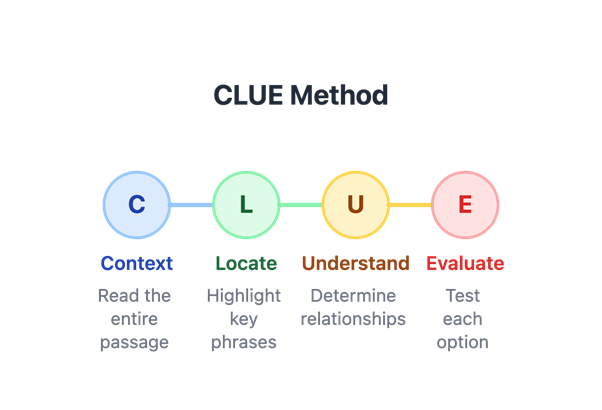
: To consistently solve Word in Context questions correctly, we've developed the CLUE method - a systematic four-step approach that will guide you to the right answer every time. C stands for Context: carefully read the entire passage, not just the sentence containing the blank. Pay attention to the overall tone, purpose, and main ideas to establish a framework for understanding. L stands for Locate: identify and highlight key phrases that provide clues about the missing word's meaning. Look for defining phrases, examples, contrasts, or synonyms that clarify what the blank represents. U stands for Understand: determine the relationship these clues have with the blank - are they defining it, contrasting with it, providing examples, or establishing cause and effect? This step helps you determine what function the word in the blank needs to serve. E stands for Evaluate: test each answer choice in the blank to see which one best maintains the meaning established by your analysis. Eliminate options that change the meaning or don't align with your context clues. Let's apply this method step-by-step to some practice questions to see how it works.
Key Points
C - Context: Read the entire passage to understand the overall message
L - Locate: Highlight key phrases and clues surrounding the blank
U - Understand: Determine how these clues relate to what belongs in the blank
E - Evaluate: Test each option systematically against your identified clues
PRACTICE QUESTION 1
Social stratification refers to the layered structure of society, where individuals are ranked according to various factors like wealth, power, and social status. This system creates a complex hierarchy that influences individuals' access to resources and opportunities. Within this framework, social mobility is a key concept, describing the movement of individuals or groups within these social strata. The possibility of social mobility suggests a society where the layers are ______, allowing for upward or downward movement based on merit or effort.
- social mobility is a key concept, describing the movement of individuals or groups within these social strata C-L: Key phrase identifying movement between layers
- allowing for upward or downward movement based on merit or effort U: Confirms layers must allow passage between them
Giải thích:
'Permeable' means allowing things to pass through - perfect for layers that allow movement between them. 'Visible' doesn't address movement capability, 'equitable' refers to fairness rather than movement, and 'theoretical' suggests the layers might not exist at all, which contradicts the passage.
Bài nghe
Phát bài học
Audio Transcript
Let's tackle our first practice question using the CLUE method. First, Context: this passage discusses social stratification - how society is structured in layers based on wealth, power, and status. This creates a hierarchy affecting access to resources. Next, Locate: we've highlighted two key phrases that provide clues about what the blank requires. The mention of 'movement of individuals or groups within these social strata' and 'upward or downward movement' both strongly suggest the blank needs a word relating to passage between layers. Then, Understand: these phrases tell us the answer relates to movement between social layers, suggesting the layers must allow people to pass through them rather than being rigid boundaries. Finally, Evaluate: testing each option, 'permeable' (allowing passage through) is the only one that supports the concept of movement between layers. 'Visible' means they can be seen but says nothing about movement; 'equitable' means fair or equal, which isn't related to movement; and 'theoretical' suggests the layers aren't real, contradicting the passage.
Key Points
C - Context: The passage discusses social stratification (society in layers) and social mobility (movement between layers)
L - Locate: Key phrases about 'movement of individuals' and 'upward or downward movement'
U - Understand: These phrases tell us the social layers must allow people to move between them
E - Evaluate: 'Permeable' (allowing passage through) is the only option supporting movement between layers
PRACTICE QUESTION 2
Photosynthesis is the process by which plants convert light energy into chemical energy. Through specialized structures called chloroplasts, plants are able to ______ the sun's radiation and transform it into glucose, which fuels the plant's growth and metabolic activities. This remarkable adaptation allows plants to create their own food source, unlike animals which must consume other organisms to obtain energy.
- convert light energy into chemical energy C-L: Plants are transforming one energy form to another
- transform it into glucose U: Plants are making practical use of the sun's radiation
Giải thích:
'Utilize' means to make practical use of something, which perfectly fits how plants use sunlight in photosynthesis. 'Release' would mean plants are giving off radiation rather than taking it in; 'reflect' would mean bouncing it away instead of capturing it; and 'filter' suggests removing parts of the radiation rather than using it.
Bài nghe
Phát bài học
Audio Transcript
For our second question, we'll apply the CLUE method step by step.
Context: this passage explains photosynthesis, the process plants use to
create energy from sunlight. We see that plants 'convert light energy into
chemical energy' and 'transform it into glucose,' so the blank must refer to
how plants interact with sunlight to begin this process. Locate: we've
highlighted two key phrases that show how plants interact with sunlight:
'convert light energy into chemical energy' and 'transform it into glucose.'
These phrases indicate that plants are taking energy from the sun and
changing its form. Understand: the relationship shows plants are taking
something from sunlight and converting it to another form (glucose) for their
own benefit. The word in the blank must reflect this active usage of
sunlight. Evaluate: only 'utilize' correctly expresses making practical use
of sunlight to create energy. 'Release' would mean giving off radiation (the
opposite of what plants do with sunlight); 'reflect' would mean bouncing
sunlight away (which would prevent photosynthesis); and 'filter' suggests
removing parts of the radiation rather than using it productively.
Key Points
- C - Context: The passage explains photosynthesis, how plants create energy from sunlight
- L - Locate: Key phrases about 'converting energy' and 'transforming into glucose'
- U - Understand: Plants are taking sunlight and converting it to a usable form
- E - Evaluate: 'Utilize' (make practical use of) is the only option that fits this process
PRACTICE QUESTION 3
Scientific discovery is often portrayed in popular media as a series of dramatic breakthroughs, with lone geniuses making revolutionary discoveries. In reality, scientific progress is typically ______, with researchers building upon the work of their predecessors and contemporaries. Each new finding represents a small but significant addition to the collective knowledge of the scientific community, gradually pushing forward the boundaries of human understanding.
- portrayed in popular media as a series of dramatic breakthroughs C: Establishes the contrast - what science is NOT
- building upon the work of their predecessors L: Science builds on previous work rather than making sudden leaps
- small but significant addition U: Progress happens in small increments, not big jumps
- gradually pushing forward U: Direct clue indicating slow, incremental progress
Giải thích:
'Gradual' fits perfectly with the idea of small, cumulative advances described in the passage. 'Revolutionary' directly contradicts the passage's main point; 'inevitable' suggests certainty but doesn't address the pace of progress; 'theoretical' implies scientific progress might be speculative rather than real.
Bài nghe
Phát bài học
Audio Transcript
Let's apply the CLUE method to our third question. Context: the passage contrasts the popular perception of scientific discovery with reality. It sets up a contrast between how science is portrayed in media (dramatic breakthroughs by lone geniuses) versus how it actually works. Locate: we've highlighted several key phrases that tell us how scientific progress actually happens. Notice phrases like 'building upon the work of their predecessors,' 'small but significant addition,' and 'gradually pushing forward,' all indicating an incremental process. Understand: the contrast shows that real science isn't about sudden breakthroughs but accumulates slowly over time through collaborative effort. The word in the blank needs to express this slow, cumulative nature that contrasts with 'dramatic breakthroughs.' Evaluate: 'gradual' is the only option that captures this slow, incremental process. 'Revolutionary' would contradict the passage by supporting the media portrayal the author is arguing against; 'inevitable' suggests certainty but doesn't address the key contrast about pace; and 'theoretical' implies scientific progress might not be real, which contradicts the factual tone of the passage.
Key Points
C - Context: The passage contrasts popular perception of science with reality
L - Locate: Key phrases about 'building upon work', 'small additions', and 'gradually pushing forward'
U - Understand: Real science happens through small, cumulative steps rather than sudden breakthroughs
E - Evaluate: 'Gradual' (occurring in small increments over time) is the only option matching this reality
PRACTICE QUESTION 4
Economic policies designed to address unemployment must balance multiple objectives. While focusing on job creation, policymakers must also consider inflation rates, interest rates, and market stability. The most effective approaches tend to be those that target the root causes of unemployment while attempting to ______ any negative consequences that might affect other sectors of the economy or vulnerable populations.
- balance multiple objectives C: Economic policies must manage different goals simultaneously
- the most effective approaches L: Indicates what makes policies successful
- negative consequences that might affect other sectors U: These are unwanted side effects that need to be minimized
Giải thích:
'Alleviate' means to make less severe - this aligns perfectly with the context of reducing negative impacts. 'Exacerbate' means to make worse, the opposite of what effective policies would do; 'anticipate' means to foresee but doesn't imply addressing the consequences; 'acknowledge' means to recognize but doesn't suggest taking action.
Bài nghe
Phát bài học
Audio Transcript
For our fourth question, let's walk through the CLUE method. Context: this passage discusses how policymakers address unemployment while managing other economic factors. It mentions 'balancing multiple objectives' and considering various economic indicators, suggesting a complex approach is needed. Locate: we've highlighted phrases about balancing objectives and what makes approaches effective. The passage explains that effective policies address unemployment's root causes while doing something about 'negative consequences that might affect other sectors.' Understand: these tell us policymakers want to minimize harm from their unemployment policies. The missing word must express the idea of reducing or lessening these negative effects. Evaluate: 'alleviate' (reduce severity) is the only option that suggests minimizing negative effects. 'Exacerbate' means to make worse, which is the opposite of what effective policies would do; 'anticipate' means to foresee or expect, but doesn't imply taking action to reduce consequences; and 'acknowledge' means to recognize or admit, but again doesn't suggest taking steps to minimize the harm.
Key Points
C - Context: The passage explains how economic policies must address unemployment while managing other factors
L - Locate: Key phrases about 'balancing objectives' and dealing with 'negative consequences'
U - Understand: Good policies should minimize harmful side effects while fixing unemployment
E - Evaluate: 'Alleviate' (make less severe) is the only option that means to reduce negative effects
PRACTICE QUESTION 5
The artist's masterful use of perspective is evident in the landscape's composition. Through ______ gradations of color, the mountains appear to recede into the distance, creating a remarkable sense of depth. This technique, known as aerial perspective, mimics the way atmospheric conditions affect our perception of distant objects, making them appear lighter and less distinct than objects in the foreground.
- gradations of color C-L: Describes transitions between colors
- mountains appear to recede into the distance L: The effect created by the color technique
- lighter and less distinct than objects in the foreground U: Shows the changes are subtle rather than dramatic
Giải thích:
'Nuanced' means characterized by slight, fine differences - this matches perfectly with the gradual color changes needed to create depth perception. 'Dramatic' suggests bold, attention-grabbing changes rather than subtle ones; 'garish' means excessively bright or gaudy, inappropriate for a realistic depth effect; 'monotonous' means lacking variety, which would prevent the depth effect described.
Bài nghe
Phát bài học
Audio Transcript
For our fifth question, let's apply the full CLUE method. Context: the passage describes an artistic technique creating depth in a landscape painting through the use of color gradations that mimic atmospheric effects. Locate: we've highlighted phrases about color gradations and how distant objects appear. The passage mentions 'gradations of color' creating the effect of mountains receding into the distance, and explains that distant objects appear 'lighter and less distinct.' Understand: these tell us the color changes must be subtle and delicate to create a natural depth effect. The atmospheric perspective technique relies on gentle transitions rather than bold contrasts. Evaluate: 'nuanced' (having slight, fine differences) is the only option supporting this subtle effect. 'Dramatic' would suggest bold, attention-grabbing changes rather than the subtle transitions needed for realistic depth; 'garish' means excessively bright or gaudy, which would create an unrealistic appearance; and 'monotonous' means lacking variety, which would prevent the depth effect from working at all.
Key Points
C - Context: The passage describes an artistic technique for creating depth perception in painting
L - Locate: Key phrases about 'gradations of color' and objects appearing 'lighter and less distinct'
U - Understand: The color changes create depth through subtle transitions rather than bold contrasts
E - Evaluate: 'Nuanced' (having subtle differences) is the only option that matches this effect
PRACTICE QUESTION 6
The journalist's approach to the controversial topic was ______, presenting multiple perspectives and acknowledging the validity of competing viewpoints rather than advocating for a particular position. This reporting style earned praise from critics across the political spectrum, who appreciated the thoughtful examination of complex issues without the partisan framing that characterizes much of contemporary media coverage.
- presenting multiple perspectives and acknowledging the validity of competing viewpoints C-L: Shows the journalist fairly represented different sides
- rather than advocating for a particular position L: Indicates the journalist avoided bias
- without the partisan framing that characterizes much of contemporary media U: The approach contrasts with typical biased reporting
Giải thích:
'Impartial' means not biased or partisan - this perfectly matches the description of presenting multiple perspectives fairly. 'Indifferent' suggests lack of interest or concern; 'incomplete' suggests missing important elements; 'inconsistent' suggests contradictions or lack of coherence - none of which align with the positive portrayal in the passage.
Bài nghe
Phát bài học
Audio Transcript
For our sixth question, let's apply the CLUE method thoroughly. Context: the passage describes a journalist's approach to a controversial topic and how it was received positively by critics. Locate: we can identify key phrases that describe the journalist's approach, including 'presenting multiple perspectives,' 'acknowledging the validity of competing viewpoints,' and 'without the partisan framing.' Understand: these phrases tell us the journalist was fair and unbiased, showing different sides of the issue without pushing a particular agenda. The word in the blank needs to describe this balanced, non-partisan approach. Evaluate: 'impartial' (not favoring one side over another) is the only option that captures this fair, balanced approach. 'Indifferent' would mean the journalist didn't care about the topic, which contradicts the 'thoughtful examination' mentioned; 'incomplete' would suggest the reporting was missing important elements, contradicting the praise it received; and 'inconsistent' would imply contradictions or lack of coherence, which doesn't match the description of a methodology that earned widespread praise.
Key Points
C - Context: The passage describes a journalist's approach to a controversial topic that received positive reception
L - Locate: Key phrases about 'presenting multiple perspectives' and avoiding ‘partisan framing’
U - Understand: The journalist showed different sides fairly without pushing an agenda
E - Evaluate: 'Impartial' (not biased) is the only option that matches this balanced approach
PRACTICE QUESTION 7
The public health campaign was designed to ______ common misconceptions about vaccination, addressing concerns with scientific evidence while acknowledging the importance of personal choice. By creating educational materials that explained complex medical concepts in accessible language, the campaign sought to provide accurate information that would enable individuals to make informed decisions about their health.
- addressing concerns with scientific evidence C-L: Shows the campaign uses facts to correct misunderstandings
- educational materials that explained complex medical concepts L: The campaign provides clear, factual information
- provide accurate information U: The campaign aims to correct misconceptions with facts
Giải thích:
'Dispute' means to challenge or disagree with - this fits the context of correcting misconceptions with scientific evidence. 'Perpetuate' means to make something continue indefinitely, which would mean spreading misconceptions; 'exaggerate' means to represent as larger or worse; 'exploit' means to take advantage of unfairly - none of which align with the educational goals described.
Bài nghe
Phát bài học
Audio Transcript
Let's work through our seventh question using the CLUE method. Context: the passage describes a public health campaign about vaccination that uses scientific evidence while respecting personal choice. Locate: key phrases include 'addressing concerns with scientific evidence' and creating materials that 'explained complex medical concepts' to 'provide accurate information.' Understand: these phrases indicate the campaign aims to correct misunderstandings while providing factual information. The word in the blank must describe challenging or correcting incorrect ideas. Evaluate: 'dispute' (to challenge or disagree with) is the only option that fits this context of correcting misconceptions. 'Perpetuate' would mean continuing or prolonging misconceptions, the opposite of the campaign's goal; 'exaggerate' would mean overstating misconceptions, which contradicts the focus on 'scientific evidence' and 'accurate information'; and 'exploit' would mean taking unfair advantage of misconceptions, which doesn't align with the respectful, educational approach described.
Key Points
C - Context: The passage describes a vaccination public health campaign that uses scientific evidence while respecting personal choice
L - Locate: Key phrases about 'addressing concerns with scientific evidence' and providing 'accurate information'
U - Understand: The campaign aims to correct misunderstandings while providing facts
E - Evaluate: 'Dispute' (challenge or disagree with) is the only option that fits correcting misconceptions
PRACTICE QUESTION 8
The entrepreneur's business philosophy ______ the conventional wisdom that profit should be the primary measure of success. Instead, she emphasized the importance of creating sustainable products, fostering a positive workplace culture, and contributing to community development. This holistic approach proved remarkably effective, ultimately generating both social benefits and strong financial returns.
- conventional wisdom that profit should be the primary measure of success C: Establishes what the entrepreneur opposed
- Instead, she emphasized L: Shows a contrast with conventional wisdom
- holistic approach U: Describes her alternative business philosophy
Giải thích:
'Challenged' means to question or dispute - this matches the entrepreneur's
alternative approach to business that goes beyond just profit. 'Reinforced'
would mean strengthened conventional wisdom, contradicting the passage;
'exemplified' would mean perfectly illustrated conventional wisdom;
'misinterpreted' suggests a misunderstanding rather than a deliberate
alternative approach.
Bài nghe
Phát bài học
Audio Transcript
For our eighth practice question, let's apply our CLUE method systematically. Context: the passage describes an entrepreneur's business philosophy that focuses on more than just profits, including sustainable products, workplace culture, and community development. Locate: we can identify a clear contrast between conventional profit-focused business wisdom and the entrepreneur's different approach, which is described as 'holistic' and emphasizes multiple factors beyond financial gain. Understand: this contrast shows the entrepreneur is taking a different path from conventional business thinking. The word in the blank must express opposition to or questioning of traditional business approaches. Evaluate: 'challenged' (questioned or disputed) is the only option that correctly expresses this opposition to conventional wisdom. 'Reinforced' would mean strengthened conventional profit-focused thinking, which contradicts the passage; 'exemplified' would mean the entrepreneur perfectly illustrated conventional wisdom, also contradicting the passage; and 'misinterpreted' would suggest the entrepreneur misunderstood conventional wisdom rather than deliberately choosing a different approach.
Key Points
C - Context: The passage describes an entrepreneur with a business philosophy that goes beyond just profit
L - Locate: Key phrases showing contrast between 'conventional wisdom' about profit and 'instead, she emphasized' other factors
U - Understand: The entrepreneur took a different path from conventional business thinking
E - Evaluate: 'Challenged' (questioned or disputed) is the only option that expresses opposition to conventional wisdom
RECOGNIZING PATTERNS & STRATEGIES
Key Signal Words to Watch For
1. Contrast Indicators
Watch for: however, but, unlike, instead, rather than
Why they matter: A contrast word usually means the correct answer will oppose another idea in the sentence.
2. Definition Markers
Watch for: in other words, that is, which means, namely, specifically
Why they matter: The phrase directly defines the blank—match it to the answer choice.
3. Example Signals
Watch for: for example, such as, including, like
Why they matter: Examples narrow the blank to the same category or type.
4. Cause-and-Effect Cues
Watch for: therefore, as a result, consequently, because, leading to
Why they matter: Spotting the logical link clarifies whether the blank is positive/negative or active/passive.
How the CLUE Method Uses These Patterns
Context – locate the signal words
Logic – determine the blank’s relationship to the rest of the sentence
Understanding – predict the word’s meaning before looking at the options
Elimination – discard choices that violate the observed pattern
Common Wrong-Answer Traps
Contradicts the passage’s main idea
Obsesses over a minor detail and ignores the core concept
Fits another context but not this specific sentence
Putting It All Together
Scan for signal words.
Analyze the relationship around the blank.
Apply the CLUE steps.
Eliminate answers that match the traps above.
By combining pattern recognition with the systematic CLUE approach, you can tackle even the toughest Word-in-Context questions with confidence.
Bài nghe
Phát bài học
Audio Transcript
Now that we've worked through several practice questions, let's identify patterns that can help you recognize and solve Word in Context questions more efficiently. First, pay special attention to contrast words like 'however,' 'but,' 'unlike,' 'instead,' and 'rather than' - these often signal relationships that provide crucial context clues. Second, look for defining phrases that directly explain what belongs in the blank, such as 'in other words,' 'that is,' or 'which means.' Third, watch for examples that illustrate the concept in the blank. Fourth, notice cause-and-effect relationships that show what the blank word does or causes. The CLUE method works because it systematically identifies these patterns and uses them to eliminate wrong answers. Remember that wrong answers often: contradict the passage's main point, focus on a minor detail while missing the big picture, or use words with completely unrelated meanings. By applying these pattern recognition strategies alongside the CLUE method, you'll be able to tackle even the most challenging Word in Context questions with confidence.
Key Points
Pay attention to contrast indicators: 'however,' 'but,' 'unlike,' 'instead'
Look for defining phrases: 'in other words,' 'that is,' 'which means'
Watch for examples that illustrate the blank's concept
Notice cause-and-effect relationships
Common wrong answers: contradict main point, focus on minor details, or use unrelated meanings
Test strategies: When stuck, try each option and see which one maintains passage coherence
SUMMARY & FINAL TIPS
Master Summary: Word-in-Context Success
The CLUE Method (recap)
C – Context: read the entire passage
L – Locate: find key phrases & signal words
U – Understand: identify relationships to the blank
E – Evaluate: test each option systematically
Timing Benchmarks
45 – 60 seconds per question
• 15–20 sec: read & find context
• 20–30 sec: apply CLUE
• 10–15 sec: verify answer
Speed Boosters
Trust your first instinct after using CLUE.
If torn between two choices, pick the one that keeps the passage coherent.
Mark difficult items and return if time allows.
Drill with a timer to build pace without losing accuracy.
Vocabulary-Building Plan
Daily 15–20 min
Learn 10–15 SAT-level words (focus on multiple meanings).
Study them in context, not isolation.
Use spaced-repetition apps (Anki, Quizlet).
Power Tactics
Group words into families (ambiguous → ambiguity → disambiguate).
Master Latin & Greek roots to decode new terms.
Read challenging sources: opinion pieces, science journals, literature.
Keep a vocabulary journal with original example sentences.
Critical Test-Day Reminders
Trust the process – CLUE for every question.
Context is king – the answer must be supported by the passage.
Eliminate extremes – beware of absolutist words (always, never).
Stay consistent – match the passage’s tone & purpose.
Watch for traps:
Literal meanings that ignore context.
“Fancy” words that don’t fit.
Choices that contradict the main idea.
Final Success Formula
Before the test
Complete ≥ 50 CLUE-driven practice questions.
Review every mistake until you understand why.
Build vocabulary methodically, not randomly.
Time yourself to ensure you can maintain pace.
During the test
Stay calm & methodical.
Use elimination aggressively.
Don’t spend > 90 sec on a single question.
Trust your preparation—and the CLUE method.
Your Path to Success
Word-in-Context items are predictable. Master:
Pattern recognition (contrast, definition, example, cause-effect).
The systematic CLUE approach.
Strategic vocabulary growth.
Efficient pacing.
Consistent practice turns challenges into guaranteed points.
In the weeks before the exam, do 10–15 Word-in-Context questions daily—CLUE will become second nature, improving both speed and accuracy.
Bài nghe
Phát bài học
Audio Transcript
Congratulations on completing this comprehensive walkthrough of SAT Word in Context questions! Let's summarize the key strategies we've covered. The CLUE method provides a systematic approach: Context (read the entire passage), Locate (identify key phrases and clues), Understand (determine relationships to the blank), and Evaluate (test each option systematically). Remember that context clues can appear before or after the blank, so check the entire paragraph. Tone and purpose matter - make sure your answer fits the passage's overall tone. Practice identifying types of context clues: definitions, contrasts, examples, and cause-effect relationships. When evaluating answer choices, eliminate options that change the meaning, contradict the passage, or focus on minor details. With consistent practice using the CLUE method, you'll develop the skills to quickly identify context clues and select the correct answer, even under time pressure. Remember that Word in Context questions follow predictable patterns, and using a systematic approach like CLUE will significantly improve your performance on test day. Good luck with your SAT preparation!
Key Points
Always use the CLUE method systematically for every Word in Context question
Pay special attention to contrast words like 'however,' 'but,' 'unlike'
Look for defining phrases that explain relationships
Practice identifying different types of context clues
Eliminate answers that change meaning or contradict the passage
Check that your answer maintains the passage's tone and purpose
Remember that context clues can appear before or after the blank
Develop speed through consistent practice with the CLUE method
Aim for 45-60 seconds per question on test day
Study vocabulary in context, focusing on words with multiple meanings
Build word families and learn common roots to decode unfamiliar words
Complete at least 50 practice questions before your test date

Congratulations!
You've completed SAT Lesson: Word in Context. You can review the lesson again, or move on to the next lesson.